
Randolph Previous Residents by Era
A Randolph address has no single continuous history file. The useful record changes with the period. Modern tax records identify the current parcel and owner of record. The Clerk’s online index carries recorded-property clues into the second half of the twentieth century. Libraries, archives, maps, and census schedules carry the trail deeper. The table separates coverage dates from the kind of evidence each source supplies, which helps prevent an old directory entry from being confused with a deed or a current parcel result.
| Source | Years it covers | Where held | What it shows |
|---|---|---|---|
| Morris Tax Search | 2000–2026 observed | Morris Tax Board web | Owner, location, block, lot, prior identifiers, tax fields |
| Morris Clerk online index | 1960–present | NewVision public search | Recorded instrument parties and details |
| Clerk Records Vault | Late 1700s–present | Morristown counter, mail, books, microfilm | Older deeds, mortgages, maps, and copy requests |
| Morris County Directories | 1897–1909 | North Jersey History & Genealogy Center | County and community address or name entries |
| Morristown City Directories | 1885–1982 | Morristown & Morris Township Library | Nearby county-seat household and business entries |
| County building contracts | 1853–1972 | Morris County Archives | Owner and contractor construction evidence |
| Federal census | Released through 1950 | NARA and library databases | Household, age, birthplace, and relationship clues |
| Randolph tax ratables | 1806, 1808–1818, 1822 | New Jersey State Archives | Early taxpayer and property context |
For a recent ownership question, begin with the Tax Board and Clerk. For an earlier household question, begin with the deed date, then choose the nearest directory and census period. For a pre-township question, also search Mendham records because Randolph was formed from Mendham in 1805 and organized in 1806.
Start a Randolph Address History
Begin with today’s parcel, even when the goal is to find past residents. In the Morris Tax Board Search Tax Records interface, select the Randolph Township district and a tax year. Search by property location, owner, block and lot, or prior block and lot. Capture the property location, owner of record, current block, lot, qualifier, and any prior identifiers. The tax card may show an owner correspondence address, but that is not the same thing as the property’s situs address and should remain labeled as a separate clue.
The basic path is: current street address → tax parcel → owner of record and legal parcel → Clerk deed index → earlier recorded owner → historical directory or census. Each arrow means a comparison, not an automatic match. A street number may change, a lot may split, and an owner can have a different mailing location. For a current parcel walkthrough across a named road, use the Randolph street directory record trail.
Trace Randolph Previous Residents Through Deeds
The Morris County Clerk’s recorded-document index provides the backward ownership trail. Search the current tax owner under Party Name, using last name then first name without a comma. Select a deed or set a date range when useful, and compare the result with the tax parcel. The relevant result fields can include the parties, recording date, instrument number, book and page, consideration, legal description, district, map, parcel, verification status, and available image. Save those details before following a name backward.
- Use the current Tax Board record to identify the owner, block, lot, qualifier, and legal parcel context.
- Search that owner as the grantee, or buyer, in the Clerk Party Name route and find the recorded purchase deed.
- Read the deed’s grantor, or seller, plus its legal description, instrument number, and book/page reference.
- Search that seller as a grantee in an earlier period and compare the legal parcel before accepting the next deed.
- Repeat the sequence until the parcel no longer matches or the online index reaches its 1960 boundary, then move to the Records Vault.
The Morris Clerk recorded-document search is the official interface for the Party Name, deed, parcel, and book/page routes.
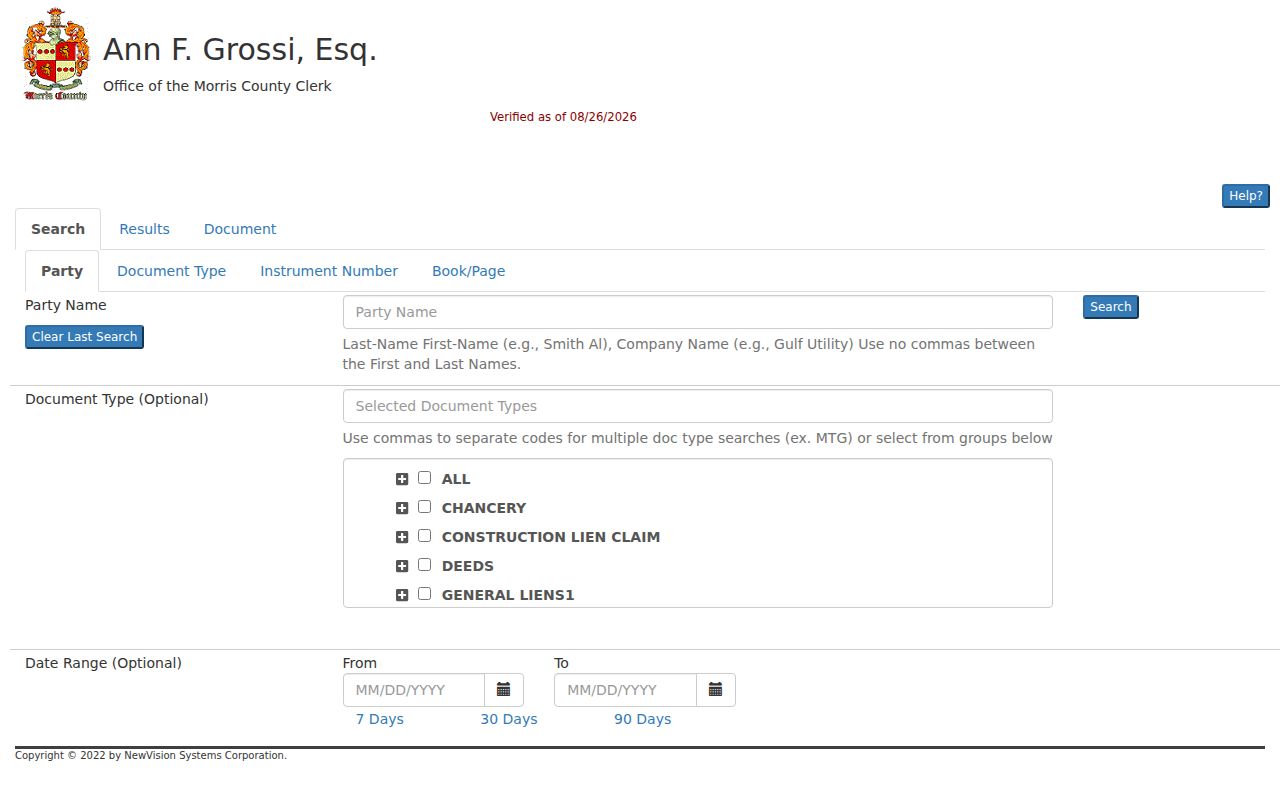
The image is only the entry point. The legal description and parcel match are what keep two same-name parties or similarly numbered properties from being combined incorrectly.
- Grantor and grantee
- The grantor transfers an interest in the deed; the grantee receives it.
- Chain of title
- The linked sequence of recorded transfers for the same property or legal parcel.
- Legal description
- The parcel wording in a deed or map. It can remain useful when a street address changes.
- Instrument number
- A Clerk recording identifier used to locate one document within the property index.
Randolph’s 1960 Index Boundary
The Clerk’s official online-property-records page states that the online index reaches back to 1960. This is an access boundary, not the beginning of the property’s history. The Morris County Historical Society’s 2022 house-history guide describes online deeds reaching at least into the 1960s, so the current Clerk statement is the safer published cutoff to use. When the backward chain reaches that point, preserve the book/page, party, legal description, and last confirmed date before changing access channels.
The County Clerk coverage page explains the online index and directs older or certified-copy needs to the Records Vault.
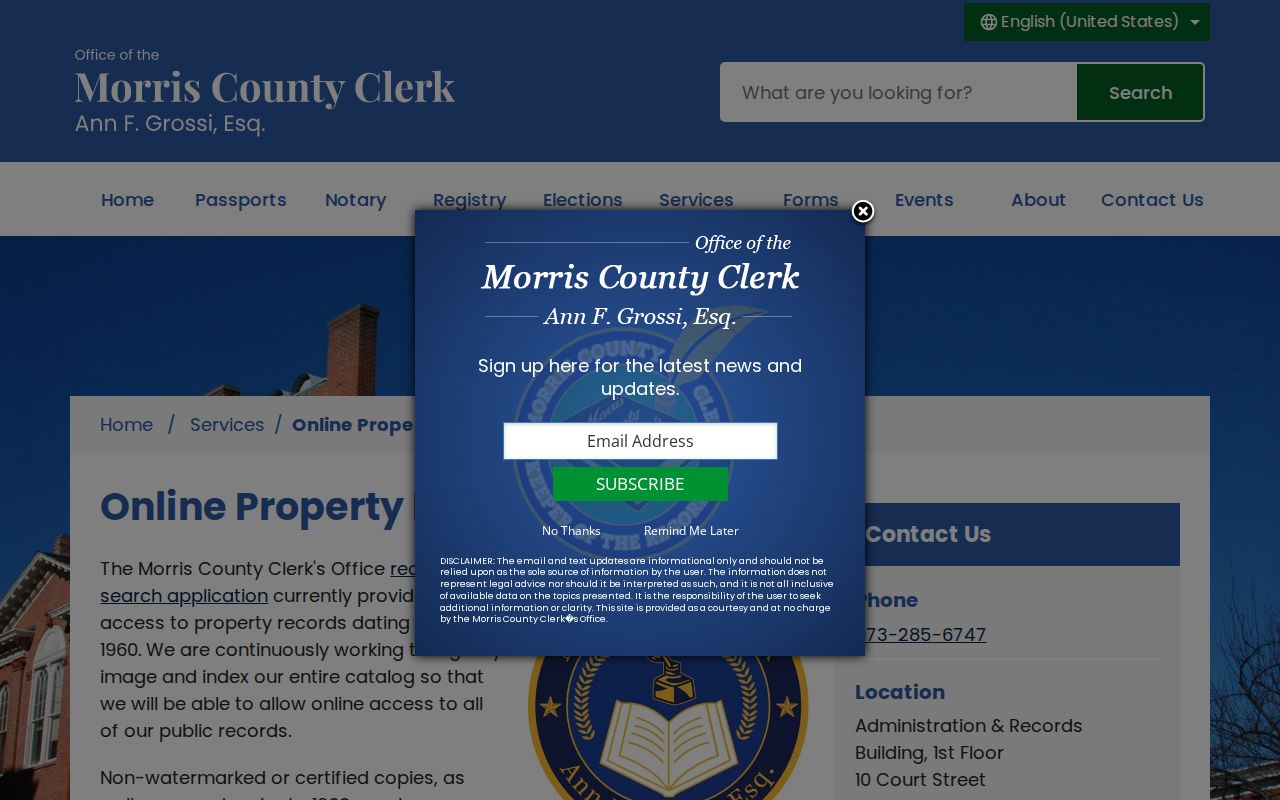
Older records are still available through the proper channel. Do not infer a missing web result means the deed does not exist.
The Morris County Clerk Records Vault holds books, microfilm, and digital images dating to the late 1700s. It supports counter research and mail requests for older material; a mail request should identify the document generally, name the parties when known, include book/page if known, a return address, and payment under the Vault instructions.
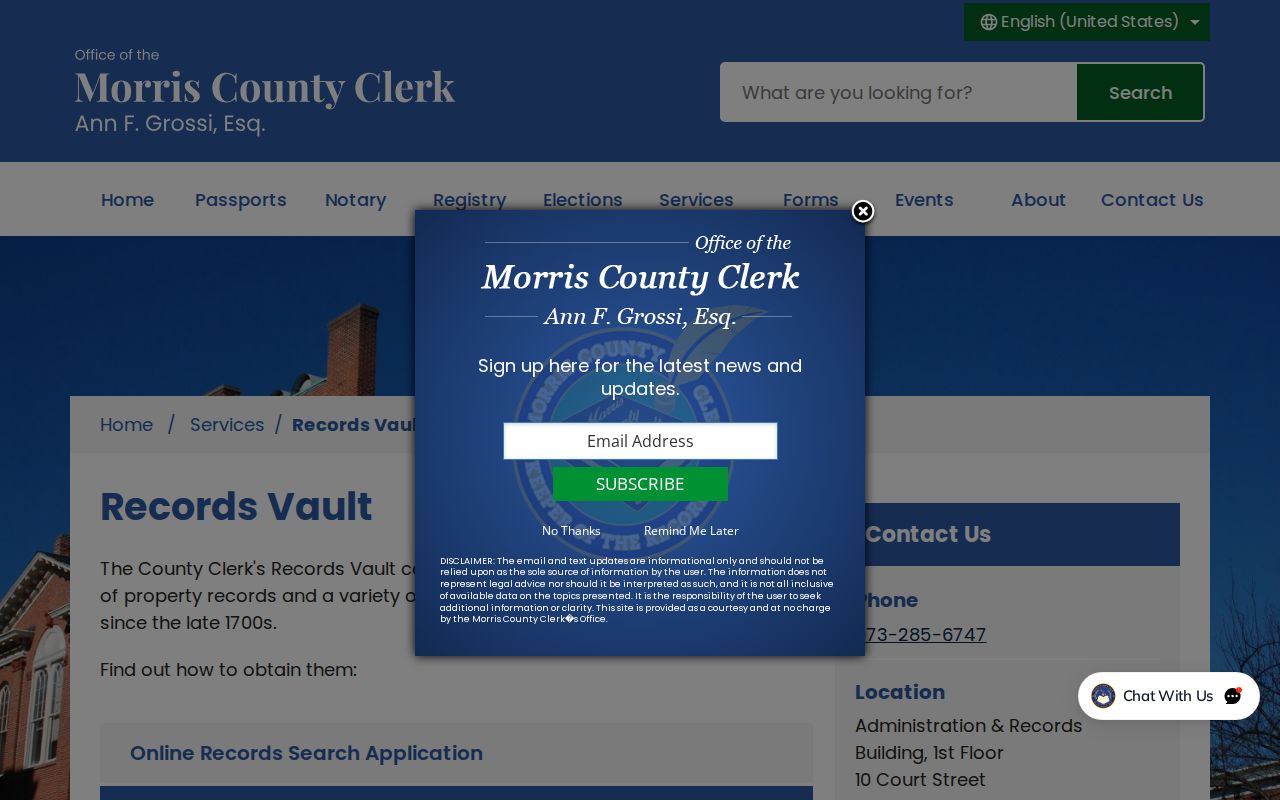
The Vault is also the route for non-watermarked and certified copies. The researched fee schedule lists certified copies at $1 per page plus $10 certification, while the Vault describes historical non-certified mail-copy instructions as $2 per page and $1 postage without a self-addressed stamped envelope.
Randolph Previous Residents and Parcel Changes
Previous residents research can go wrong when a modern street address is used as the only key. A parcel can be divided, renumbered, shown under a prior block and lot, or described by map and lot rather than a current road number. Morris Tax Search includes a prior-block-and-lot route for exactly that problem. Keep both current and prior identifiers in the research log, then compare the legal description on deeds and plats before carrying a person backward to an earlier parcel.
Historic Randolph also uses several community and postal names. Ironia, Mount Freedom, Shongum, Center Grove, and Fernbrook can occur in a record without creating a separate governing municipality. A very early record may instead say Mendham Township. These naming changes are clues to search, not proof that a modern address had the same wording.
Randolph Past Residents in Directories
Once a deed sequence establishes a dated owner or address, use directories to ask who was associated with the location around that time. Historical directories may be alphabetical or arranged by street. A reverse or criss-cross section lets a researcher read house numbers in order. Capture the spelling, spouse notation, historical role, street number, telephone, and abbreviation key exactly as printed. Directories help verify a timeline but do not replace the recorded ownership evidence.
Pair a directory year immediately before or after a census year. The flow is: deed date → nearest directory entry → matching federal or state census → deed or tax record check. Federal schedules are publicly released through 1950, with the 1890 loss noted. New Jersey state censuses run from 1855 to 1915, with early incompleteness and a complete 1895 reference. A mismatch can be a lead about a move, a changed name, or a different property, not a reason to force a match.
Morris County Directories span 1897–1909, Morristown City Directories 1885–1982, area telephone directories start in 1969, and State Library Phonefiche supplies changing area titles for 1976–2005. The holdings and how entries read are covered on the Randolph directory book; the key here is pairing a selected volume with the deed trail for one house.
Maps for Randolph Previous Residents
Map evidence helps when a deed describes a farm, landmark, road, or community rather than a current house number. The documented sequence includes an 1868 Randolph Township map, 1887 Morris atlas references, and a 1986 historic survey. County Archives road returns from 1741–1915 can identify a road layout and adjoining owners. County building contracts from 1853–1972 can supply construction context. Both are available at Morris County Archives by research appointment at Morris County Library.
No Randolph-specific Sanborn fire-insurance map run was located in the official sources reviewed. Nearby Morris material does not establish a Randolph plate. Use the located maps and legal descriptions first, and ask the Township historian, Randolph Museum/HSOR, or the archive about a particular place. The Museum’s circa-1867 Trowbridge-Brundage House and its family history show the sort of local context that can support a carefully documented house history.
Randolph Address Trail Endpoints
When the deed and directory trail approaches a later life event, municipal permits, obituaries, and probate can provide time markers. Randolph Construction Codes keeps address-keyed permit, inspection, and certificate files, but no online permit-results database was found. Submit a specific request with the address, block and lot, permit number, or year through Construction Codes or the Township Clerk’s OPRA route. A permit identifies a project connection, not necessarily every person at an address.
For a deceased owner or family member, the Morris County Surrogate’s Search Probated Estates route can point to wills, executors, administrators, inventories, and heir relationships. Obituaries and historic newspapers may add a former address, relationship, or funeral information. Confirm those details against a deed, tax record, or probate file before using them to extend the chain.
Limits on Randolph Previous Residents
A deed records a transfer, not every household member. A tax result identifies an owner of record, not all people who stayed at a parcel. Directories and census schedules are dated snapshots, and a name match can belong to another person with the same name. Utility customer files and motor-vehicle personal information are not open address-history sources. Protected addresses, sealed court material, and confidential vital records also create intentional gaps.
Use these sources for personal house history, family history, estate questions, and civic curiosity. Label each fact by source, date, and role. New Jersey’s anti-stalking law, N.J.S.A. 2C:12-10, prohibits conduct that causes reasonable fear, so a historical search must not become tracking, unwanted contact, harassment, or harm.
Lawful use. Randolph house-history research should stay personal and respectful. Verify with the record custodian, protect sensitive details, and never use a past-resident trail to stalk, harass, or harm anyone.